A waterfront home is only as good as the wall holding the water back. Seawall condition rarely shows up in listing photos, and it's one of the most expensive surprises a Gulf access buyer can find after closing — repair and replacement runs from the high four figures into six figures depending on length and severity. It's worth understanding before you write an offer, not after.
What Is Seawall "Kick-Out"?
Kick-out is when the base of a seawall panel shifts or slides outward — usually because the soil behind the wall has eroded away and built-up water pressure (hydrostatic pressure) has pushed the panel out of position. It's a structural failure, not a cosmetic one, and it tends to get worse, not better, if left alone.
Warning Signs to Check Before You Buy
- Cracks — vertical cracks often point to settlement; horizontal cracks often point to pressure pushing the wall outward.
- Tilting or leaning — even a slight visible angle can mean the wall is already being pushed out of position.
- Gaps between panels — joint separation lets water and soil escape from behind the wall, accelerating erosion.
- Erosion at the base — visible loss of soil or a hollow sound underfoot near the wall.
- Exposed or rust-stained rebar — a sign saltwater has already reached the internal steel reinforcement.
- Standing water behind the wall after rain — often a sign that weep holes are clogged and pressure is building.
None of this replaces a proper inspection. A marine engineer can assess a seawall's condition far more reliably than a walk-through, and for a purchase this size, that's money well spent before closing, not after.
Not every crack means a problem.
Concrete changes over time.
Some imperfections are cosmetic.
Others deserve closer attention.
Knowing the difference begins with asking the right questions.
What Causes Seawall Failure in Florida
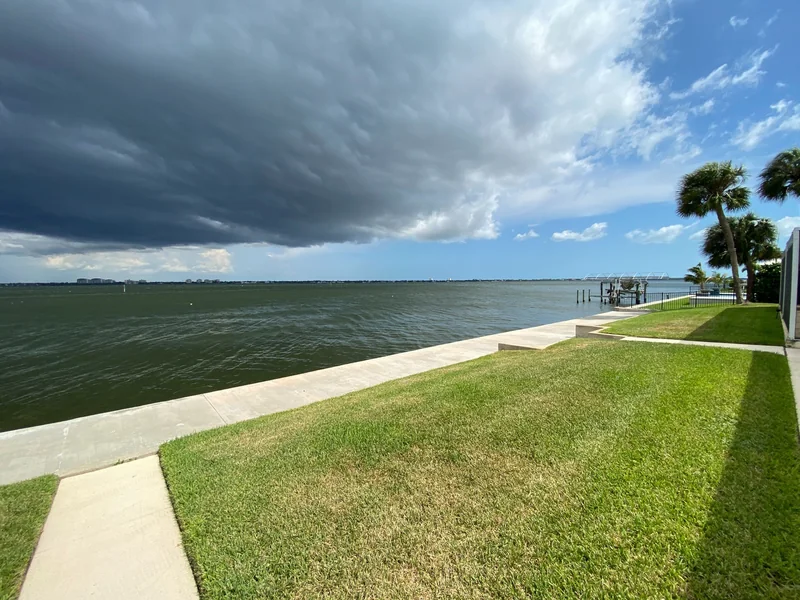
Florida's conditions are particularly hard on seawalls. The most common causes: poor drainage and clogged weep holes building up hydrostatic pressure behind the wall; Florida's sandy soil offering weak load-bearing support to begin with; saltwater corroding internal steel reinforcement over time; storm surge during hurricanes temporarily raising water levels well beyond normal design conditions; and, less often, improper original installation — inadequate soil compaction or poor joint sealing that lets water carry soil through the wall from day one.
Repair vs. Replacement Costs (2026)
As a general range for Cape Coral: concrete panel seawalls typically run about $650–$900 per linear foot, and vinyl sheet pile seawalls about $400–$650 per linear foot. A straightforward repair (addressing a section, not a full replacement) costs meaningfully less than a full teardown and rebuild — but a wall with genuine kick-out usually can't be spot-repaired for long.
What moves the number, in both directions: material choice, anchoring systems (tiebacks and deadmen), whether the site allows land-based access or requires a marine barge, dock and boat lift protection during construction, and how much of the old wall needs demolition and disposal. A poorly planned project can cost close to twice a well-planned one for the same wall — get a detailed, line-item proposal, not a single number.
Permitting: What Cape Coral Requires
Residential seawall repair in Cape Coral requires a Marine Improvement permit. At minimum, that means engineering specifications signed and sealed by a Florida-licensed Professional Engineer, a site plan showing the seawall's location and length, and standard affidavits (owner/builder and burrowing owl/gopher tortoise). Before the first inspection, the project also needs either DEP approval or a SAJ-91 (except in freshwater areas), plus a recorded Notice of Commencement if the project's value exceeds $2,500. Licensed marine contractors (or a qualifying owner/builder) can apply.
This is exactly the kind of requirement that surprises buyers who assume "repair" means a quick fix — it doesn't skip the engineering step, and that step takes real time to schedule.
Common Mistakes Buyers Make
The most common one: assuming a seawall that "looks fine" from the yard is structurally fine. Minor cracking and slight discoloration are easy to miss on a walk-through, and by the time kick-out is visible to an untrained eye, the repair is usually the expensive kind. The second: treating a seawall estimate as a formality rather than a real number to negotiate around before closing.
Frequently Asked Questions
What is seawall "kick-out"?
Kick-out is when the base of a seawall shifts or slides outward, usually because soil behind the wall has eroded away and hydrostatic pressure has pushed the panel out of position. It's a structural failure, not a cosmetic one.
How much does a Cape Coral seawall cost to replace in 2026?
As a general range, concrete panel seawalls typically run about $650 to $900 per linear foot, and vinyl sheet pile seawalls about $400 to $650 per linear foot, before accounting for access, permitting, and site-specific factors.
Do I need a permit to repair or replace a seawall in Cape Coral?
Yes. Cape Coral requires a Marine Improvement permit for residential seawall repair, including engineering plans signed and sealed by a Florida-licensed engineer, along with state and county approvals before the first inspection.
Can I tell if a seawall is failing just by looking at it?
Often, yes, though not always. Visible cracking, leaning, gaps between panels, soil erosion at the base, exposed or rust-stained rebar, and standing water pooling behind the wall are all warning signs worth a closer look before buying.
Who typically pays for seawall replacement — buyer or seller?
It's negotiable, like any other repair item, but a seawall in poor condition should factor directly into an offer given the cost involved. Getting a marine engineer's assessment before closing is standard practice, not overcaution.
Read the full Gulf Access Guide → · Bridge Heights & Sailboat Access →
Buying a home with an older seawall?
Christina flags seawall condition during a showing, before it becomes a post-closing surprise — and can point you to a marine engineer for a real assessment.